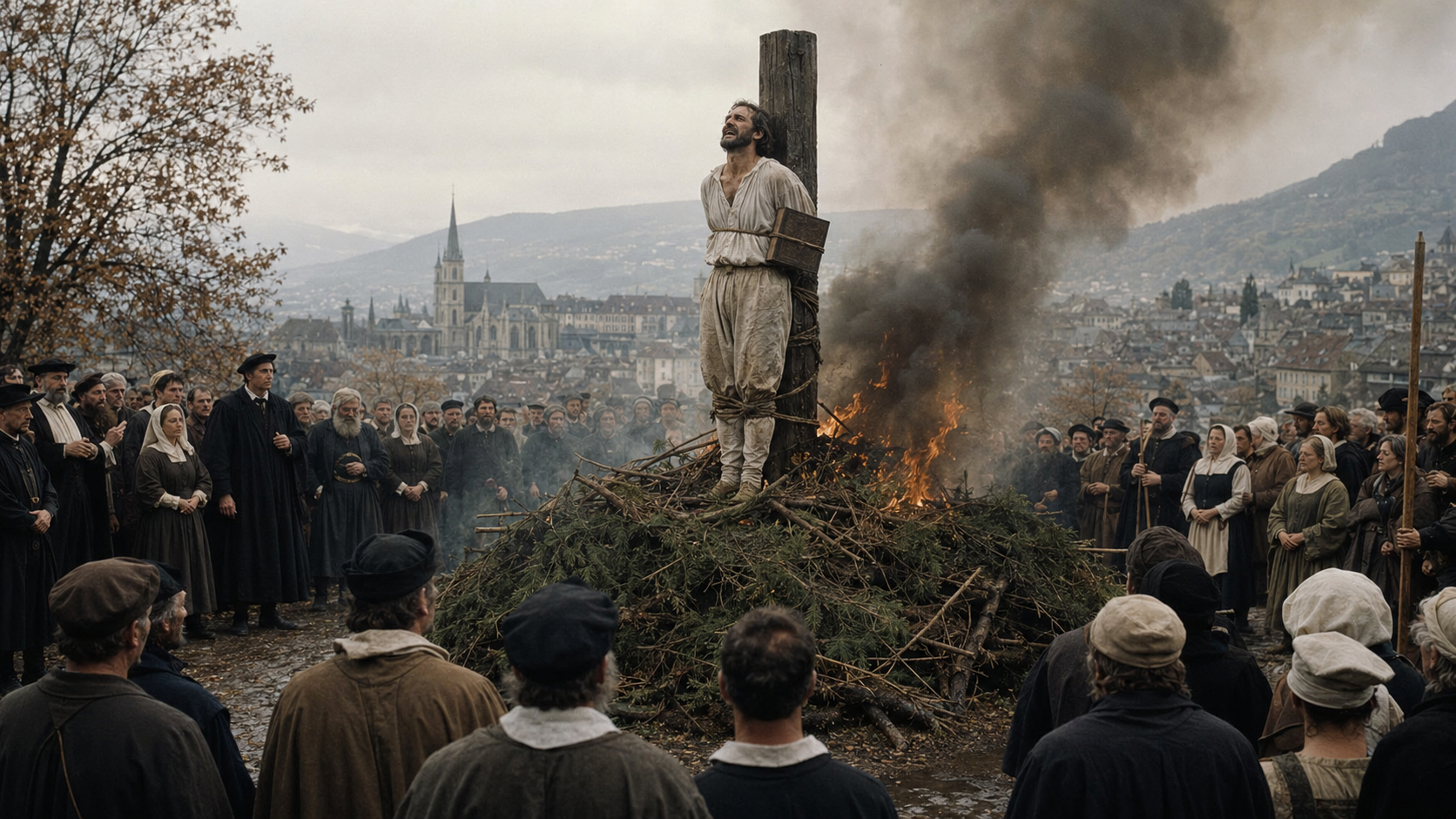
A scholarly examination of Calvin’s role in the persecution and execution of Anabaptists and those deemed heretical in Reformation-era Geneva
Preface
Few figures in Protestant history have attracted more controversy than John Calvin (1509–1564), the French theologian who became the dominant ecclesiastical force in Geneva from 1541 until his death. His intellectual contributions to Reformed theology are vast — the Institutes of the Christian Religion (1536, revised 1559) remain foundational to Calvinist doctrine worldwide. Yet alongside that legacy stands a darker record: Calvin’s documented advocacy for the use of civil power to suppress, exile, and execute those he judged heretical. This article draws on primary sources including John Foxe’s Acts and Monuments (commonly known as the Book of Martyrs), Philip Schaff’s monumental History of the Christian Church, Calvin’s own published writings, and a range of secondary historical scholarship to present as complete and balanced a picture as the evidence allows.
I. Calvin’s Geneva: The Theocratic Framework
To understand Calvin’s involvement in religious persecution, one must first understand the governing framework he helped construct in Geneva. When Calvin returned to Geneva in September 1541 — having been expelled in 1538 — he immediately moved to establish a disciplinary structure that fused ecclesiastical and civil authority.
Calvin’s governing instrument was the Consistory, a body of pastors and lay elders with authority over moral and doctrinal conduct. While the Consistory could not formally condemn people to death (that was the prerogative of the civil Small Council), it could — and did — refer cases to the secular authorities, whose punishments ranged from fines and public humiliation to exile and execution.
Philip Schaff, in his History of the Christian Church, Vol. VIII, describes the arrangement plainly: the civil government was understood to be the “nursing father” of the church, with a duty to protect orthodoxy and punish blasphemy and heresy as crimes against God and the civic order. Calvin himself wrote in the Institutes:
“The Church has no power of the sword to punish or to coerce… The difference therefore is very great; because the Church does not assume to itself what belongs to the magistrate, nor can the magistrate execute that which is executed by the Church.”
— Calvin, Institutes of the Christian Religion (1536), cited in University of Chicago Founders’ Documents
Yet in practice, the boundary was porous: Calvin regularly provided theological justification for civil action, drafted indictments, and openly urged the Council to act against those he identified as dangerous heretics.
II. The 58 Executions: Separating Fact from Legend
A figure that circulates widely in popular and polemical literature is that Calvin “caused” 58 executions and 76 banishments during the years 1541 to 1546. This statistic appears in sources ranging from Encyclopedia.com to Catholic polemicists like Fr. Leonel Franca in Calvin the Tyrant of Geneva.
The number itself is historically documented. The official acts of the Geneva Council record executions during this period. However, the historical analysis of why these people were executed is significantly more contested:
- Most historians — including Protestant scholars — acknowledge that the majority of those executed were condemned for secular crimes such as plague-spreading, murder, adultery, and witchcraft during the epidemic years of 1542–1546.
- During an epidemic of pestilence from 1542 to 1546, approximately 58 women and men suspected of spreading plague through witchcraft were sentenced to death (Swiss Reformation records, cited in multiple sources).
- Calvin himself was not a citizen of Geneva until 1559 and held no formal legal authority over the council’s sentencing during much of this period.
- Historian Bruce Gordon and others note that many of the 76 banishments targeted Calvin’s political opponents in the Libertine faction rather than theological dissenters per se.
Nevertheless, scholars on multiple sides of the debate agree that Calvin morally approved of capital punishment for heresy and actively advocated for it in public writing and private correspondence.
III. Foxe’s Book of Martyrs and Calvin
John Foxe (1516–1587), the Protestant martyrologist, was a contemporary of Calvin and broadly sympathetic to the Reformed cause. His Actes and Monuments (first published 1563), commonly called the Book of Martyrs, is one of the most significant primary Protestant sources for Reformation-era persecution.
Significantly, Foxe chose to address the Servetus affair directly. He wrote:
“It has been often asserted, that Calvin possessed so much influence with the magistrates of Geneva that he might have obtained the release of Servetus, had he not been desirous of his destruction. This however, is not true. So far from it, that Calvin was himself once banished from Geneva, by these very magistrates, and often opposed their arbitrary measures in vain. So little desirous was Calvin of procuring the death of Servetus that he warned him of his danger, and suffered him to remain several weeks at Geneva, before he was arrested. But his language, which was then accounted blasphemous, was the cause of his imprisonment. When in prison, Calvin visited him, and used every argument to persuade him to retract his horrible blasphemies, without reference to his peculiar sentiments. This was the extent of Calvin’s agency in this unhappy affair. It cannot, however, be denied, that in this instance, Calvin acted contrary to the benignant spirit of the Gospel.”
— John Foxe, Acts and Monuments (Fox113, Christian Classics Ethereal Library edition)
This passage is important for several reasons. First, Foxe — a friend and ally of Calvin — nonetheless explicitly states that Calvin acted “contrary to the benignant spirit of the Gospel.” Second, Foxe defends Calvin on procedural grounds (Calvin lacked the formal authority to release Servetus), not on moral grounds. Third, and crucially, Foxe largely omits from his martyrology the substantial persecution of Anabaptists by Reformed and Lutheran authorities — a silence that later historians have noted and criticized.
As one commentator on Foxe noted: “Foxe was a contemporary and close friend with John Calvin and he decided not to include in his book the many accounts of Lutherans, Zwinglians and Calvinists persecuting, drowning, beheading and outright murdering their own enemies with great zeal and hatred — such as Anabaptists.” (A Theology in Tension, citing historical scholarship). This editorial omission skews Foxe’s Book of Martyrs significantly in favor of Reformed persecution being invisible while Catholic persecution is exhaustively documented.
IV. The Servetus Affair (1553): The Defining Case
Background
Michael Servetus (c. 1511–1553) was a Spanish physician and theologian who had, since 1531, publicly denied the orthodox doctrine of the Trinity and had also been associated with Anabaptist views on baptism. He engaged in private correspondence with Calvin beginning in the 1540s, and their relationship was combative from the start.
Calvin wrote to his colleague William Farel on February 13, 1546 — seven years before Servetus’s execution:
“Servetus lately wrote to me, and coupled with his letter a long volume of his delirious fancies, with the Thrasonic boast, that I should see something astonishing and unheard of. He offers to come hither, if it be agreeable to me. But I am unwilling to pledge my word for his safety, for if he shall come, I shall never permit him to depart alive, provided my authority be of any avail.”
— Calvin, Letter to William Farel, February 13, 1546 (Selected Works of John Calvin: Tracts and Letters, Vol. 5, ed. Beveridge and Bonnet, Baker Book House reprint)
This letter, written years before the Vienne and Geneva trials, demonstrates that Calvin had already decided Servetus’s fate should he appear in Geneva.
The Trial at Vienne
In February 1553, Calvin’s friend Guillaume de Trie wrote a letter to his Catholic cousin in Lyon, denouncing Servetus as a heretic. He provided personal correspondence between Calvin and Servetus to the Catholic Inquisition in Vienne. Servetus was arrested by Roman Catholic authorities on April 4, 1553, but escaped from prison three days later. He was tried in absentia and convicted of heresy on June 17, 1553, and burned in effigy.
Historians have debated the extent to which Calvin was directly responsible for tipping off the Inquisition at Vienne through de Trie. The evidence strongly suggests Calvin approved, if not directed, the disclosure. He later defended his role in a 1562 work:
“Servetus suffered the penalty due to his heresies, but was it by my will? Certainly his arrogance destroyed him not less than his impiety. And what crime was it of mine if our Council, at my exhortation, indeed, but in conformity with the opinion of several Churches, took vengeance on his execrable blasphemies?”
— Calvin, Responsio ad Balduini Convicia (1562), Opera, IX. 575; in Schaff, History of the Christian Church, Vol. VIII, §136
The phrase “at my exhortation” is Calvin’s own admission of his active advocacy.
Arrest and Trial in Geneva
En route to Italy, Servetus made the fatal decision to pass through Geneva, where he was recognized at a Sunday worship service at St. Peter’s Cathedral and arrested on August 13, 1553. Calvin’s indictment against Servetus charged him with thirty-nine counts of heresy and blasphemy. Calvin was called as chief witness for the prosecution.
The trial proceeded before Geneva’s civil Small Council. Calvin was not yet a citizen of Geneva (he did not receive citizenship until 1559), and the council — many members of which were in fact Calvin’s political enemies in the Libertine faction — had the final vote on the sentence. They consulted other Swiss Reformed cities including Zurich, Berne, Schaffhausen, and Basel, all of which affirmed that Servetus deserved severe punishment.
Calvin’s own request — notably absent from most popular accounts — was that Servetus be executed by beheading rather than burning, as the latter was considered a more painful and degrading death. The Council refused this request and sentenced Servetus to death by burning at a slow fire of green wood.
The Execution, October 27, 1553
Servetus was burned at the stake at Champel, outside Geneva, on October 27, 1553. According to the Hektoen International medical history journal: “The council decided to have him slowly roasted at the stake in a fire made expressly of green wood so that it would burn more slowly and prolong his agony.” Contemporary accounts record that the execution took approximately thirty minutes.
Calvin later wrote a mocking description of Servetus’s reaction to his death sentence, recorded in his Defence of Orthodox Faith (1554):
“Lest idle scoundrels should glory in the insane obstinacy of the man as in a martyrdom, there appeared in his death a beastly stupidity… he stood fixed: now as one astounded: now he sighed deeply: and now he howled like a maniac: and at length he just gained strength enough to bellow out after the Spanish manner — Mercy! Mercy!”
— Calvin, Defence of Orthodox Faith against the Prodigious Errors of the Spaniard Michael Servetus (1554), cited in Philip Schaff, History of the Reformation, Vol. 2, p. 791; and in Stanford Rives, Did Calvin Murder Servetus? (Infinity, 2008), pp. 348–349, 410–411
V. Calvin’s Written Defense of Executing Heretics
Declaratio Orthodoxae Fidei (1554)
Perhaps the most damning evidence of Calvin’s ideological commitment to heresy executions is his own published treatise. Four months after Servetus’s death, in January 1554, Calvin published Declaratio orthodoxae fidei (Declaration of the Orthodox Faith), a systematic defense of the civil magistrate’s duty to execute heretics. The full Latin text is preserved in Calvini Opera, Vol. VIII, pp. 453–644.
Joseph Lecler, S.J., in his comprehensive Toleration and the Reformation (New York: Association Press, 1960), describes this work as “one of the most frightening treatises ever written to justify the persecution of heretics” (Vol. 1, p. 333). Calvin wrote:
“Our sympathy-mongers, who take such great pleasure in leaving heresies unpunished, now see that their fantasy hardly conforms with God’s commandment… But God does not even allow whole towns and populations to be spared, but will have the walls razed and the memory of the inhabitants destroyed and all things frustrated as a sign of his utter detestation, lest the contagion spread. He even gives us to understand that by concealing a crime one becomes an accomplice.”
— Calvin, Declaratio orthodoxae fidei (1554), cited in Lecler, Toleration and the Reformation, Vol. 1, pp. 333–334
“I ask you, is it reasonable that heretics should be allowed to murder souls and to poison them with their false doctrine, and that we should prevent the sword, contrary to God’s command?”
— Ibid.
The Last Admonition (1557)
In 1557, four years after the Servetus execution, Calvin reiterated his position in Last Admonition to Joachim Westphal:
“First, he maintains, that to prevent the contagion from spreading, sectaries and heretics are to be banished or otherwise subjected to punishment.”
— Calvin, Last Admonition (1557), in Tracts Relating to the Reformation, Vol. 2 (Calvin Translation Society, 1849), pp. 357–358
Calvin also confirmed in his Second Defence in Answer to the Calumnies of Joachim Westphal: “Servetus, who was both an anabaptist and the worst of heretics, agreed entirely with Westphal…” (Tracts and Treatises, II. 264; cited in Calvin’s Conflict with the Anabaptists, Biblical Studies, 1982, p. 46).
VI. The Anabaptist Question: Broader Persecution
Calvin’s Theological Opposition to Anabaptists
Calvin reserved some of his harshest theological venom for the Anabaptists — a loose term applied to those who rejected infant baptism, advocated church-state separation, preached general atonement, or held pacifist views. In his own writings he regularly grouped Anabaptists with Servetus as the most dangerous of heretics.
His view was consistent with the dominant Magisterial Reformation position: that it was the duty of the Christian state to suppress not only criminal behavior but doctrinal error, using force if necessary. Schaff writes in History of the Christian Church, Vol. VIII: “Calvin was a promoter of magisterial reform in which it was the right, yes the duty, of the government to punish heresy.”
Persecution in Geneva and the Swiss Cantons
While Calvin’s direct legal authority over specific Anabaptist executions in Geneva is harder to document individually than the Servetus case, the broader Reformed persecution of Anabaptists in the Swiss cantons was extensive and documented:
- Joseph Lecler documented that “at least forty Anabaptists were executed in Berne between 1528 and 1571.” (Toleration and the Reformation, Vol. 1, p. 324)
- In Geneva, Zurich, and Berne, Anabaptists were exiled without mercy or put to death.
- The Dutch Protestant martyrology records 877 martyrs for the sixteenth century, of which 617 — approximately two-thirds — were Anabaptists (Lecler, cited in Dave Armstrong, Patheos, 2021).
- The common methods of execution included drowning (mockingly called a “third baptism”), beheading, and burning at the stake. In Calvin’s Geneva, residents were compelled to witness these public executions.
- Anabaptist Felix Manz, the leader of the Zurich Anabaptists, was drowned by the Reformed (Zwinglian) authorities in 1527 — a practice that continued under Reformed governance generally.
Calvin’s own Institutes and commentaries consistently branded Anabaptist doctrines as seditious and heretical. He described those who denied infant baptism as threatening both the church and the social order.
VII. Other Notable Cases of Calvin’s Disciplinary Action
Jacques Gruet (Executed 1547)
Gruet was a Genevan Libertine who posted an anonymous note on Calvin’s pulpit calling him an “ambitious and haughty hypocrite.” He was arrested, subjected to torture twice daily over the course of a month to extract a confession, tried for blasphemy, sedition, and heresy, and beheaded on July 26, 1547. His house was burned, his writings destroyed, and his family left destitute. Philip Schaff identifies Gruet as “the first victim of Calvin’s discipline who suffered death for sedition and blasphemy” (History of the Christian Church, Vol. VIII, §109). Calvin concurred with the sentence.
Jérôme Bolsec (Exiled 1551)
Bolsec was a former Carmelite monk turned Reformed pastor who publicly challenged Calvin’s doctrine of double predestination in 1551. Calvin had Bolsec arrested and sought the death penalty. The Council, after consulting Swiss churches, instead imposed exile. Calvin later wrote privately that he wished Bolsec were “rotting in a ditch.” Bolsec later converted back to Catholicism and wrote a hostile biography of Calvin — Histoire de la vie, moeurs, actes, doctrine, constance et mort de Jean Calvin (1577) — which Schaff discusses at length as an “anti-Calvinistic” source.
Sebastian Castellio (Harassed, Not Executed)
Castellio (1515–1563) was a humanist scholar who initially worked with Calvin in Geneva but was expelled in 1544 after theological disputes. After Servetus’s execution, Castellio wrote the famous Treatise on Heretics (1554) under the alias “Martin Bellius,” gathering patristic and contemporary arguments against executing heretics. His most enduring critique of Calvin appeared in a later work (Contra libellum Calvini, written 1554, published posthumously 1612):
“To kill a man is not to defend a doctrine, it is to kill a man. When the Genevans killed Servetus, they did not defend a doctrine, they killed a man… Servetus fought with arguments and writings: he should have been fought with arguments and writings.”
— Sebastian Castellio, Against Calvin’s Booklet (1554/1612), Article 77
Calvin pursued Castellio relentlessly, attempting to have him charged with heresy by the Basel authorities. Castellio died in 1563 before a formal trial could be mounted.
Giovanni Valentino Gentile (Sentenced 1558)
Gentile was an Italian exile in Geneva who held Subordinationist views — believing Christ to be a person subordinate to God the Father. He was denounced and tried for heresy and blasphemy by Calvin himself in June 1558, resulting in a sentence of beheading. Gentile recanted and performed public penance, escaping execution at that point, but was later beheaded in Berne in 1566 for the same views. (Wikipedia, “Giovanni Valentino Gentile,” citing Gary W. Jenkins)
VIII. Calvin’s Own Defense and Contemporaneous Response
Calvin was aware that his actions were controversial even in his own time. He defended the Servetus execution in multiple later writings:
“Servetus suffered the penalty due to his heresies, but was it by my will? Certainly his arrogance destroyed him not less than his impiety. And what crime was it of mine if our Council, at my exhortation, indeed, but in conformity with the opinion of several Churches, took vengeance on his execrable blasphemies? Let Baudouin abuse me as long as he will, provided that, by the judgment of Melanchthon, posterity owes me a debt of gratitude for having purged the Church of so pernicious a monster.”
— Calvin, Responsio ad Balduini Convicia (1562), Opera, IX. 575; in Schaff, History of the Christian Church, Vol. VIII, §136
His contemporary critics were not silent. The Reformer Philip Melanchthon notably expressed approval of the execution in 1553 and 1554, writing that “Servetus was justly punished at Geneva, not as a sectary, but as a monster made up of nothing but impiety and horrid blasphemies” (cited in Beza, De haereticis a civili magistratu puniendis, 1554; in Schaff, Vol. VIII). But others condemned it. Heinrich Bullinger of Zurich expressed discomfort with Calvin’s published defense of heresy execution, writing in a letter of January 10, 1554: “I do not see how you can find any favor with men of sedate mind in being the first formally to treat this subject, which is a hateful one to almost all” (cited in Dave Armstrong, Patheos, 2021).
IX. Historiographical Debate: How Much Was Calvin Responsible?
Those Who Minimize Calvin’s Personal Culpability
(e.g., Michael A. G. Haykin, 5 Myths about John Calvin, Crossway, 2019) argue:
- Calvin was not a Genevan citizen during most of these events and held no formal legal authority.
- The council that sentenced Servetus was dominated by Calvin’s enemies, the Libertines, who wished to assert their independence.
- Calvin actively requested a more merciful form of execution (beheading vs. burning).
- Calvin warned Servetus not to come to Geneva.
Those Who Emphasize Calvin’s Substantial Responsibility
(including Schaff, Lecler, Roland Bainton, Stanford Rives) argue:
- Calvin’s letter to Farel (1546) proves premeditation seven years before Servetus arrived.
- Calvin’s own admission of “exhortation” to the Council is a direct admission of advocacy for the execution.
- Calvin personally drafted the 39-count indictment that convicted Servetus.
- Calvin published multiple treatises defending heresy executions after the fact.
- Calvin’s systematic theology provided the doctrinal framework that justified execution by civil authorities throughout Reformed territories, contributing to the broader persecution of Anabaptists.
The middle ground, represented by Schaff himself in History of the Christian Church, Vol. VIII, §157, is that “the public sentiment, Catholic and Protestant, approved of the traditional doctrine that obstinate heretics should be made harmless by death” — and that Calvin’s actions, while genuinely blameworthy by New Testament standards, must be understood within this context.
X. Conclusion
The historical record is complex but not ambiguous on its core findings:
- Calvin unambiguously advocated, in print and in private correspondence, for the civil execution of those he deemed heretics — Anabaptists, anti-Trinitarians, and political-theological opponents alike.
- Calvin played a direct and admitted role in the arrest, indictment, trial, and execution of Michael Servetus in 1553, even if the final sentence was handed down by the Geneva civil council. His own phrase “at my exhortation” is decisive.
- Calvin approved of and concurred with the beheading of Jacques Gruet (1547) and sought the death penalty for Jérôme Bolsec.
- Calvin’s theological writings — particularly the Declaratio orthodoxae fidei (1554) — provided a systematic justification for the execution of heretics that influenced Reformed governance across Switzerland, the Netherlands, and beyond, contributing to a documented pattern of Anabaptist persecution in which hundreds were executed.
- John Foxe’s Book of Martyrs, while defending Calvin on procedural grounds in the Servetus case, acknowledges that Calvin “acted contrary to the benignant spirit of the Gospel” — and Foxe notably excluded Reformed persecution of Anabaptists from his martyrology, a selective omission that has distorted popular Protestant memory of the period.
- The debate over Calvin’s ultimate moral culpability is legitimately complicated by the norms of the 16th century, his lack of formal legal authority, and the genuine complexity of Church-State relationships in Reformation Geneva. But Calvin’s own writings make clear that he did not consider his actions a regrettable necessity — he considered them a righteous duty, and he defended them vigorously and publicly until the end of his life.
“To kill a man is not to defend a doctrine, it is to kill a man. When the Genevans killed Servetus, they did not defend a doctrine, they killed a man… Servetus fought with arguments and writings: he should have been fought with arguments and writings.”
— Sebastian Castellio, Against Calvin’s Booklet (1554/1612), Article 77 — Calvin’s most eloquent contemporary critic
Sources and Citations
Primary Sources
- Calvin, John. Letter to William Farel, February 13, 1546. In Beveridge, Henry and Jules Bonnet, eds. Selected Works of John Calvin: Tracts and Letters, Vol. 5. Philadelphia: Presbyterian Board of Publication, 1858; repr. Baker Book House.
- Calvin, John. Declaratio orthodoxae fidei (1554). Full Latin text: Calvini Opera, Vol. VIII, pp. 453–644. Post-Reformation Digital Library.
- Calvin, John. Defence of Orthodox Faith against the Prodigious Errors of the Spaniard Michael Servetus (1554). In Schaff, Philip. History of the Reformation, Vol. 2 (New York, 1892), p. 791; and in Rives, Stanford. Did Calvin Murder Servetus? Infinity, 2008.
- Calvin, John. Responsio ad Balduini Convicia (1562). Opera, IX. 575.
- Calvin, John. Second Defence in Answer to the Calumnies of Joachim Westphal. In Tracts and Treatises, Vol. II. Calvin Translation Society.
- Calvin, John. Last Admonition to Joachim Westphal (1557). In Tracts Relating to the Reformation, Vol. 2. Calvin Translation Society, 1849.
- Calvin, John. Institutes of the Christian Religion (1536, rev. 1559). Multiple editions.
- Castellio, Sebastian. Treatise on Heretics (De Haereticis) (1554). Published under alias “Martin Bellius.”
- Castellio, Sebastian. Against Calvin’s Booklet (Contra libellum Calvini) (written 1554, published posthumously 1612).
- Foxe, John. Acts and Monuments (Book of Martyrs), first published 1563. Editions consulted: Christian Classics Ethereal Library (CCEL), Fox113; RaptureReady.com transcription.
Secondary Sources
- Bainton, Roland H. Concerning Heretics. New York: Columbia University Press, 1935.
- Gordon, Bruce. Calvin. New Haven: Yale University Press, 2009.
- Haykin, Michael A. G. “5 Myths about John Calvin.” Crossway, December 1, 2019.
- Hillar, Marian. The Case of Michael Servetus (1511–1553): The Turning Point in the Struggle for Freedom of Conscience. Lewisburg: Edwin Mellen Press, 1997.
- Hillar, Marian. Michael Servetus: Intellectual Giant, Humanist, and Martyr. Lanham: University Press of America, 2002.
- Lecler, Joseph, S.J. Toleration and the Reformation, 2 vols. New York: Association Press, 1960 (from the 1955 French edition, trans. T. L. Westow).
- Mackinnon, James. Calvin and the Reformation. New York: Longmans, Green and Co., 1936.
- McNeill, John T. The History and Character of Calvinism. New York: Oxford University Press, 1967.
- Rives, Stanford. Did Calvin Murder Servetus? Infinity Publishing, 2008.
- Schaff, Philip. History of the Christian Church, Vol. VIII: Modern Christianity: The Swiss Reformation. New York: Scribner’s, 1910. Chapters §109, §136, §157.
- Williams, George Huntston. The Radical Reformation. 3rd ed. Kirksville, MO: Sixteenth Century Journal Publishers, 1992.
- Willis, Robert. Servetus and Calvin: A Study of an Important Epoch in the Early History of the Reformation. London, 1877.
- “Calvin’s Conflict with the Anabaptists.” Evangelical Quarterly (1982), Vol. 1. Biblical Studies (biblicalstudies.org.uk).
- “The Servetus Controversy.” Calvin College Meeter Center for Calvin Studies (calvin.edu).
- Armstrong, Dave. “John Calvin: Capital Punishment For ‘Heretics’ (Anabaptists, Etc.).” Patheos, November 22, 2021.
- Armstrong, Dave. “John Calvin’s 1554 Defense of the Execution of Heretics.” Patheos, June 9, 2025.
- “John Calvin: His Rule in Geneva and His Many Illnesses.” Hektoen International, May 28, 2019.