
The Hidden King:
Was Job Actually a Monarch?
What if the man on the ash heap was not simply a suffering saint — but a reigning king whose story was secretly written to point to Jesus Christ? Ancient texts buried in plain sight reveal an identity scholars have discussed for centuries that most churches have never heard.
 The Question Behind the Suffering: Who Really Was Job?
For millennia the Book of Job has been read primarily as a theodicy — a meditation on the mystery of innocent suffering. Preachers have drawn comfort from it, philosophers have wrestled with it, and skeptics have wielded it as an argument against divine providence. Yet beneath the surface of this ancient poem lies a datum of staggering consequence, one embedded in the oldest complete translation of the Hebrew Scriptures, that has largely escaped the attention of popular Christianity.
Job was not simply a pious man of the ancient East. He was a king — specifically Jobab, the second king of Edom, a fifth-generation descendant of Abraham through Esau.
This identification, attested by the Greek Septuagint, the Syriac Peshitta, the Testament of Job, the Rabbinical tradition, and towering figures of patristic scholarship including Augustine of Hippo and Ambrose of Milan, transforms the Book of Job from a private devotional text into a royal drama touching the very nerve of biblical theology. It repositions Job within the grand narrative of redemptive history: as a king who suffers without cause, who cries out for a mediator, who confesses a living Redeemer, and who is ultimately vindicated — a pattern that finds its fullest and final expression only in the Lord Jesus Christ.
This article sets out to establish the historical, textual, and theological case for Job’s royal identity; to situate that identity within its ancient Near Eastern and Israelite context; to trace the typological and Christological significance of Job’s suffering through both Testaments; and to draw out the abiding implications for God’s people across the ages.
The Evidence: Job Was an Edomite King
1. The Septuagint Coda — The Ancient Testimony Hidden in Plain Sight
The most direct ancient testimony to Job’s royal identity is the appended colophon at the conclusion of the Septuagint (LXX) text of Job, dated by most scholars to the third or second century B.C. The great Edouard Dhorme, in his landmark Commentary on the Book of Job (trans. Harold Knight, Thomas Nelson, 1984), preserves the translation:
“It appears from the Syriac book that he lived in the land of Uz, on the confines of Idumaea and Arabia. Previously his name was Jobab. After taking an Arab woman to wife he gave birth to a son whose name was Ennon. His father was Zerah, descended from Esau, and his mother was Bosorras, so that he was the fifth from Abraham… And these are the kings which reigned in Edom, a country which he too governed…”
LXX Job 42:17b–e (Dhorme translation)
This coda explicitly identifies Job with Jobab son of Zerah, whom Genesis 36:33 names as the second elected king of Edom, ruling from Bozrah. Annette Y. Reed’s groundbreaking analysis (Journal of Biblical Literature 120:1, Spring 2001, pp. 31–55) confirms that this appendix drew upon ancient sources independent of the canonical Hebrew text, giving it independent evidentiary weight. The Douay-Rheims Bible, the oldest English Catholic translation, likewise identifies Job as Jobab.
2. The Genealogical Convergence — Tracing Five Generations to Abraham
The Septuagint coda states that Job was “the fifth from Abraham.” Working through the genealogy in Genesis 36, the lineage runs: Abraham → Esau → Eliphaz → Teman → Zerah → Jobab. This makes Jobab the great-great-great-grandson of Abraham — precisely the fifth generation — perfectly synchronized with the era of the patriarchs, before the Mosaic Law and before Israel’s national covenant at Sinai.
This genealogical anchor also explains one of the Book of Job’s most puzzling features: it contains no reference to the Torah, to Israel, to the priesthood, or to any distinctively Israelite institution. Job was a man of God who predated, or existed alongside, the covenant community — a Gentile worshipper of the God of Abraham, living in the pre-Law era of patriarchal faith.
| Evidence | Detail |
|---|---|
| Septuagint Coda | Explicitly names Job as “Jobab,” the second king of Edom who “governed” that country (LXX Job 42:17b–e) |
| Genealogical Lineage | Fifth from Abraham: Esau → Eliphaz → Teman → Zerah → Jobab (Gen. 36:33) |
| Geographic Location | The land of Uz is consistently associated with Edomite territory (Lam. 4:21; Jer. 25:20) |
| Friend Eliphaz | Eliphaz the Temanite is the son of Esau — Job’s own ancestral kinsman (Gen. 36:4, 10–12) |
| Patristic Consensus | Augustine of Hippo and Ambrose of Milan both identified Jobab and Job as the same man |
| Testament of Job | Intertestamental pseudepigraphal text identifies Job as Jobab, descendant of Esau |
| Rabbinical Tradition | The Talmud (Bava Batra 15b) affirms Job’s connection to Edomite royalty |
| Immense Wealth | 7,000 sheep, 3,000 camels, 500 yoke of oxen, 500 donkeys (Job 1:3) — consistent with royal treasury |
| Job’s Own Words | “I sat as their chief; I dwelt as a king among his troops” (Job 29:25) |
| Title “Greatest in the East” | Job 1:3 — “the greatest of all the people of the East” — a kingly designation |
3. Job 29: A King Remembers His Throne
The internal evidence of the Book of Job itself is decisive. In the great discourse of Job 29 — universally recognized as one of the most magnificent passages in all ancient literature — Job describes his former estate in unmistakably regal terms:
“When I went to the gate of the city and took my seat in the public square, the young men saw me and stepped aside, and the old men rose to their feet; the chief men refrained from speaking and covered their mouths with their hands… I chose the way for them and sat as their chief; I dwelt as a king among his troops, as one who comforts mourners.”
Job 29:7–10, 25 (NIV)
The Hebrew of verse 25 is unambiguous: wəʾēšeḇ rōʾš — “I sat as head/chief” — and kəmeleḵ baggəḏûḏ — “as a king in the army/troop.” Matthew Henry noted that Job’s description here is of a man whose “presence puts life, and courage, and joy into the whole army.” The Pulpit Commentary adds that Job’s gate-sitting, his legislative pronouncements, his adjudication of the poor’s cause, and his command over vast resources all point to the role of a city-state sovereign — a pattern exactly matching the Edomite elective monarchy of the pre-Sinaitic era.
“Job’s position as king or leader of his people makes clear that the attack upon Job came not because he was an ordinary person, but because of his preeminent position in this community, which had fallen into chaos seemingly as a result of God’s judgment upon Job, their king.”
— René Girard, Job: The Victim of His People (Stanford University Press, 1987)
4. The Land of Uz: Edomite Geography Confirmed
The geographical anchor is equally compelling. Matthew Henry placed the land of Uz “in the eastern part of Arabia, which lay towards Chaldea, near Euphrates.” The prophet Jeremiah associates Uz with Edom directly: “Rejoice and be glad, O Daughter of Edom, you who live in the land of Uz” (Lam. 4:21). The Institute for Creation Research (Henry M. Morris III) confirms: “The land of Uz, where Job lived as ‘the greatest of all the men of the East’… was later to become the land of Edom.” Teman, from which Job’s friend Eliphaz came, was a well-known Edomite district, named after Teman son of Eliphaz son of Esau (Gen. 36:11, 15) — cementing the Edomite family circle of the entire book.
Historical and Cultural Context: A King Before the Law
The World Job Inhabited
To understand Job’s significance we must locate him in the pre-Sinaitic world. Job lived in the era of the patriarchs — after the Flood, after Babel, after Abraham — but before Moses and the giving of the Torah. This is the era of wisdom, in which wisdom, not codified law, was the medium of divine revelation. The books of wisdom — Job, Proverbs, Ecclesiastes — reflect this pre-Law era of God’s self-disclosure, when righteousness was reckoned not by Torah-observance but by faith, sacrifice, and fear of God.
The ancient Edomites were descendants of Abraham and Isaac through Esau. In this earliest period — before the fratricidal hostility that would later characterize Edom-Israel relations — the Edomites worshipped the God of their forefather. As the ICR notes: “As descendants of Abraham and Isaac, many of the Edomites probably continued to worship the true God in this early period — helping to explain the religious understanding of Job and his friends.” Job’s priestly intercession on behalf of his children (Job 1:5), his altar-sacrifice theology, and his friends’ understanding of divine retribution all reflect a living patriarchal faith tradition — not paganism, but the ancient worship of the God of Abraham.
God’s Witness Beyond Israel’s Borders
The placement of this royal drama outside Israel’s national borders is deeply intentional. Matthew Henry observed with eloquence: “When God called one good man out of that country [Ur], yet he left not himself without witness, but raised up another in it to be a preacher of righteousness.” This is the theology of Romans 1 lived out centuries before Paul wrote it — God was never without a witness, even among the nations.
Job, king of Edom, was that witness in the East: a righteous Gentile sovereign who knew the God of Abraham, who offered sacrifice, and who cried out in faith for a Redeemer. This has massive implications for the theology of election and the universal scope of redemption. Long before Israel became a nation, God was working His sovereign purpose through a pagan kingdom’s king. Paul’s question echoes across the centuries: “Is God the God of Jews only? Is He not the God of Gentiles too?” (Rom. 3:29). Job is Exhibit A for the affirmative.
The Edomite-Israelite Connection in Prophetic Typology
Biblical scholar James B. Jordan has shown that the triad of Noah, Job, and Daniel cited by God in Ezekiel 14:14 represents three typological categories: the righteous Gentile-spirit (Noah), the Edomite-brother (Job), and the Israelite-priest (Daniel).
“Even if these three men — Noah, Daniel and Job — were in it, they could save only themselves by their righteousness, declares the Sovereign LORD.”
Ezekiel 14:14 (NIV)
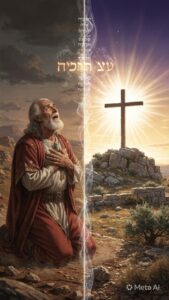
That Ezekiel would invoke Job in this tri-partite paradigm suggests that in the prophetic imagination, Job’s identity as Edomite king was not incidental but structural to his theological function. He represents the covenantal brother — related to Israel by blood, yet outside the Sinaitic covenant — who nonetheless holds fast to righteousness through suffering.
 Significance for Israel and the New Testament Church
Job as Proof That Grace Is Older Than Law
For Israel, the story of Job — once understood as the story of a suffering Edomite king, Abraham’s grandson-by-adoption — carried a thunderous theological claim: God’s saving purposes were never nationally restricted. The Book of Job pre-dates the Torah, pre-dates the priesthood, pre-dates the Temple. It shows a man without circumcision, without the written Law, without the sacrificial system of Leviticus, who yet knew God, feared God, and was declared righteous by God.
This is precisely the argument Paul marshals in Romans 4 regarding Abraham himself: “Abraham believed God, and it was credited to him as righteousness” (Rom. 4:3) — and this reckoning occurred before the institution of circumcision. Martin Luther, in his Table Talk (LW 54:80), called the Book of Job a work whose author “was a great theologian” — one who reached the heights of theological perception without the full revelation given to Israel. For the synagogue and for the early church alike, Job was living proof that grace is older than Law.
A Royal Model for the Suffering Church
The New Testament explicitly names Job as a model for the church in suffering:
“As you know, we count as blessed those who have persevered. You have heard of Job’s perseverance and have seen what the Lord finally brought about. The Lord is full of compassion and mercy.”
James 5:11 (NIV)
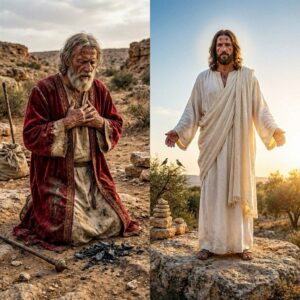
James invokes Job not as an abstraction but as a concrete historical exemplar — one whose suffering had a divine telos, a purpose-driven end. Understanding Job as a king adds a further dimension: the church is called to a royal priesthood (1 Pet. 2:9), and Job models what royal suffering in God’s service looks like. Kings are not exempt from tribulation — they are its primary target.
Furthermore, understanding Job’s royal identity illuminates the cosmic backdrop of the book. The heavenly council scene in Job 1–2 — where Satan presents himself before God and the LORD permits suffering upon Job — mirrors in miniature the cosmic drama of Ephesians 6:12: “our struggle is not against flesh and blood, but against the rulers, against the authorities, against the powers of this dark world.” Job the king becomes the arena in which cosmic principalities are confounded by a human being who refuses to curse God. This is precisely the vocation of the church.
“His purpose was that now, through the church, the manifold wisdom of God should be made known to the rulers and authorities in the heavenly realms, according to his eternal purpose that he accomplished in Christ Jesus our Lord.”
Ephesians 3:10–11 (NIV)
 Job as a Type of Jesus Christ: The Christological Blueprint
Understanding Biblical Typology
Biblical typology holds that God, who governs all history, so ordered persons, events, and institutions in the Old Testament that they foreshadow the greater realities fulfilled in Christ. Typology is not allegorism — it is grounded in history. A type must be a real historical person who, by divine design, prefigures the antitype. Job’s suffering is not a metaphor for Christ; it is a genuine, historical anticipation of a pattern that would reach its climactic fulfillment in the Passion of the Son of God.
The Book of Job occupies its canonical position — before the Psalms, in the heart of the wisdom literature, clearly pre-dating the Sinaitic covenant — by deliberate divine design. It stands as an eternal prologue to the drama of redemption the rest of Scripture narrates.
The Ten Structural Parallels Between Job and Jesus
The typological parallels between Job and Christ are not incidental — they are structural, running through the architecture of the entire book:
| Job | Jesus Christ |
|---|---|
| King of Edom (Job 29:25) | King of kings and Lord of lords (Rev. 19:16) |
| Declared “blameless and upright” (Job 1:1, 8) | “Tempted in every way, yet without sin” (Heb. 4:15) |
| Suffered “without cause” (Job 2:3) | “They hated me without reason” (John 15:25) |
| Stripped of wealth, family, health, and reputation | “Made himself nothing… humbled himself to death on a cross” (Phil. 2:7–8) |
| Falsely accused by three friends | Falsely accused before Pilate and the Sanhedrin |
| Satan challenges him before the heavenly court (Job 1:6–12) | Satan tempts Jesus in the wilderness (Matt. 4:1–11) |
| Cries for a mediator (Job 9:33) | Fulfilled: “One mediator… the man Christ Jesus” (1 Tim. 2:5) |
| Confesses a living Redeemer (Job 19:25) | Fulfilled in the bodily resurrection of Christ |
| Vindicated and restored double (Job 42:10) | Exalted to God’s right hand (Phil. 2:9–11; Heb. 1:3) |
| Intercedes for his accusers (Job 42:8) | “He always lives to intercede” (Heb. 7:25; Luke 23:34) |
“Without a doubt, God has chosen Job’s life to illustrate the suffering of Jesus on the cross. It is only through this perspective that the suffering of Job could make sense.”
— Bible Church International, Sermon Series: Preaching Jesus Christ Through the Bible
Pope Benedict XVI (Joseph Ratzinger), in Jesus of Nazareth, wrote: “Job’s sufferings are thus by anticipation sufferings in communion with Christ, who restores the honor of us all before God and shows us the way never to lose faith in God even amid the deepest darkness.”
“I Know That My Redeemer Lives” — The Old Testament’s Great Easter Text
No passage in the Book of Job has generated more theological reflection than the great confession of Job 19:25–27. In the darkest moment of his ordeal, surrounded by accusers, stripped of every dignity, Job utters what Charles Spurgeon called “the Old Testament’s great Easter text”:
“I know that my Redeemer lives, and that in the end he will stand on the earth. And after my skin has been destroyed, yet in my flesh I will see God; I myself will see him with my own eyes — I, and not another. How my heart yearns within me!”
Job 19:25–27 (NIV)
Charles Spurgeon, preaching this text in Sermon No. 504 of his Metropolitan Tabernacle Pulpit, declared with characteristic force:
“I am sorry to say that a few of those who have written upon this passage cannot see Christ or the resurrection in it at all! If it had been Job’s desire to foretell the advent of Christ and his own sure resurrection, I cannot see what better words he could have used!”
— Charles H. Spurgeon, Sermon No. 504, Metropolitan Tabernacle Pulpit
Spurgeon further expounded the Hebrew gō’ēl — the kinsman-redeemer:
“There are two redemptions — redemption by price and redemption by power, and both of these Christ hath wrought for us — by price, by his sacrifice upon the cross of Calvary; and by power, by his Divine Spirit coming into our heart, and renewing our soul.”
— Charles H. Spurgeon, Sermon No. 504
The Hebrew word gō’ēl refers to the nearest male relative empowered under ancient Near Eastern law to redeem an enslaved kinsman, avenge his blood, and restore his inheritance. Job, a descendant of Abraham, invokes this term for God Himself — a God who is kin, who will act as Redeemer, who will vindicate the suffering righteous one. This is nothing less than a pre-Christian theology of the Incarnation: God becoming our kinsman-redeemer in the flesh of Jesus Christ (Heb. 2:14–18).
The Cry for a Mediator — Job 9:33
Perhaps the most startlingly Christological passage outside Isaiah is Job 9:33:
“If only there were someone to mediate between us, someone to lay his hand on us both.”
Job 9:33 (NIV)
Alexander McLaren, in his Expositions of Holy Scripture, identified this as one of the most poignant cries in all of Scripture — a man who grasps that what he needs is not a better theology but a Person: someone who can touch both God and man, who stands between two parties otherwise separated by an infinite gulf. The ancient biblical scholar recognized what the New Testament would declare explicitly:
“For there is one God and one mediator between God and mankind, the man Christ Jesus, who gave himself as a ransom for all people.”
1 Timothy 2:5–6 (NIV)
Job wanted answers. God gave him something better — Himself. And in the fullness of time, that longing for a mediator was answered in the God-Man, Jesus Christ, who laid His hand on both divinity and humanity and bridged the infinite gulf between Creator and creature.
Job and Isaiah’s Suffering Servant
The parallel between Job and Isaiah’s Suffering Servant (Isa. 52:13–53:12) is too exact to be coincidental. Like Job, the Servant is described as blameless. Like Job, the Servant is stripped of dignity and beauty. Like Job, the Servant is abandoned by those around him. Like Job, the Servant is accused of deserving divine punishment: “we considered him punished by God, stricken by him, and afflicted” (Isa. 53:4). And like Job, the Servant is ultimately vindicated and restored.
The theological trajectory is unmistakable: Job anticipates, Isaiah prophecies, and Jesus Christ fulfills the pattern of the sovereign who suffers for others.
God’s Eternal Purpose: The Cosmic Stakes of Job’s Suffering
The Heavenly Council: A Question Before the Universe
The prologue of Job (chapters 1–2) introduces a scene unlike any other in the Hebrew Bible: the heavenly council, in which “the sons of God” present themselves before the LORD, and Satan comes among them. The adversary’s challenge is not primarily about Job — it is about God.
“Does Job fear God for nothing? Have you not put a hedge around him and his household and everything he has?”
Job 1:9–10 (NIV)
Satan’s accusation amounts to a cosmic slander: the claim that human beings only worship God for what they get, that love for God is purely transactional, and that no creature would serve God purely for His own sake. God’s answer to this charge is not a theological argument. It is a person. God points to Job — “Have you considered my servant Job?” (Job 1:8) — because Job is the living refutation of Satan’s lie.
This reveals the eternal purpose of God in Job’s suffering: not merely the testing of one man, but the cosmic demonstration of the reality of genuine faith in the sight of all created and angelic beings. Job’s suffering is, in this sense, a cosmic theodicy — not God defending Himself to Job, but God using Job to vindicate the honor of grace before principalities and powers.
The Continuity Between Job and the Church
- What Job demonstrated in the ancient East — that grace produces genuine, disinterested love for God — the church is called to demonstrate to the cosmos in Christ
- Every believer who trusts God in darkness proves that Satan’s accusation is false
- Suffering saints are not merely enduring hardship — they are vindicating the grace of God before the watching heavenly realm
- This is what it means to be a royal priesthood: bearing witness to divine grace through suffering (1 Pet. 2:9; Eph. 3:10–11)
The Restoration: A Foretaste of New Creation
The restoration of Job in chapter 42 is not merely a happy ending — it is an eschatological prophecy. Job receives double what he lost (Job 42:10). His daughters are the most beautiful in the land. His years are doubled. This pattern of loss and doubled restoration is the pattern of resurrection: death swallowed up in greater life, humiliation overcome by glory, the cross followed by the empty tomb and the exaltation at the right hand of the Father.
Matthew Henry saw Job’s restoration as “a foretaste of the resurrection of the dead and the life of the world to come.” Spurgeon drew the explicit parallel: “Job rose from his dunghill to his throne; Christ rose from the grave to glory. Job’s latter end was greater than his beginning; Christ’s glory after the cross exceeds even His pre-incarnate glory.”
Job’s Suffering and the Redemptive Work of Jesus Christ
Suffering as the Medium of God’s Deepest Revelation
One of the most profound theological insights in the Book of Job is that God’s deepest self-disclosure comes through the crucible of suffering. At the beginning of the book, Job’s knowledge of God is orthodox and second-hand — inherited, confessional, correct. At the end, after the whirlwind, Job declares:
“My ears had heard of you but now my eyes have seen you.”
Job 42:5 (NIV)
Suffering was the medium through which a general, theological knowledge of God became a personal, transforming encounter with the living God. This is precisely the pattern of the cross. The disciples had heard of God. They had studied Torah. They had watched miracles. But it was only at the cross — in the darkest, most incomprehensible moment in human history — that the full depth of God’s love was finally, fully revealed:
“God demonstrates his own love for us in this: While we were still sinners, Christ died for us.”
Romans 5:8 (NIV)
The cross is the ultimate whirlwind — answering every human question about suffering not with explanation but with presence, not with argument but with sacrifice.
The Innocent Who Intercedes for the Guilty
Job’s suffering introduces into the biblical narrative a pattern that would not be fully explained until Calvary: the innocent suffering for and among the guilty. Job’s three friends, in their theological rigidity, insist that suffering is always the consequence of sin. Job’s very existence refutes this calculus. He is righteous. He suffers. And yet, the suffering of this innocent man becomes the occasion of their redemption:
“After Job had prayed for his friends, the LORD restored his fortunes and gave him twice as much as he had before.”
Job 42:10 (NIV)
The suffering righteous one becomes the intercessor for the guilty accusers. This is the gospel in miniature. Jesus, the wholly innocent One, bears suffering He did not deserve. His suffering is the occasion of intercession: “Father, forgive them, for they do not know what they are doing” (Luke 23:34). And through His suffering — not despite it — the guilty are reconciled to God.
The Love of God Proven Through — Not Despite — Suffering
Perhaps the greatest theological claim of the Book of Job is that the love of God is not disproven by suffering — it is proven through it. Satan’s accusation was that God’s love is merely transactional. The entire book is God’s answer to that lie. Job’s unbroken faith — his refusal to curse God, his wrestling with God in honest prayer rather than abandoning Him, his final confession — demonstrates that the grace of God produces a love for God that transcends calculation.
And at the cross, this same dynamic reaches its eternal climax. Jesus, the divine Son, cries out “My God, my God, why have you forsaken me?” (Matt. 27:46) — and yet does not abandon the mission of love. He endures. He commends His spirit to the Father. He loves to the end.
The cross is the ultimate answer to Satan’s accusation — not only against Job, but against every member of the human race who loves God: genuine faith, genuine love, perseveres. And the source of that perseverance is not human resolve but divine grace.
“For Christ’s love compels us, because we are convinced that one died for all, and therefore all died.”
2 Corinthians 5:14 (NIV)
Implications for the Church Today
Suffering as Royal Vocation
Understanding Job as a king who suffered transforms the church’s theology of suffering. Peter wrote to scattered, persecuted believers: “You are a chosen people, a royal priesthood, a holy nation, God’s special possession” (1 Pet. 2:9). Royal priests suffer. Job suffered. Jesus suffered. The church — called to the same royal priesthood — should not be surprised by suffering (1 Pet. 4:12). The suffering of the royal community is not a crisis of faith — it is a confirmation of vocation.
The God Who Speaks From the Whirlwind
The theophany of Job 38–41 — God speaking from the whirlwind — establishes a crucial pastoral truth: God’s answer to suffering is not a systematic explanation but a personal encounter. God does not answer Job’s “why” with a philosophy; He answers it with His presence. The church’s calling to those in suffering is not to explain God’s ways — Job’s friends tried that and were divinely rebuked — but to bring the presence of the living God through prayer, compassion, and the witness of the Word.
The Witness Before a Watching Cosmos
As the heavenly council watched Job — and as principalities and powers watched the early church — so the witness of the suffering, faithful people of God continues to resound through the heavenly realms today. Every believer who prays in the night, who trusts God when the diagnosis is terminal, who forgives when betrayed, who blesses when cursed, is doing what Job did: proving that the grace of God is real, that it produces genuine love, and that Satan’s accusation against the people of God is eternally false.
“And they triumphed over him by the blood of the Lamb and by the word of their testimony; they did not love their lives so much as to shrink from death.”
Revelation 12:11 (NIV)
The eternal purpose of God — “to bring all things in heaven and on earth together under one head, even Christ” (Eph. 1:10) — is advanced not only by evangelism and theology, but by the quiet, steadfast faithfulness of suffering saints.
Conclusion: A King Who Pointed to the King
The identification of Job as Jobab, second king of Edom, is not a curiosity of ancient translation history. It is a key that unlocks the full theological depth of one of Scripture’s most profound books. A king who suffered without cause; an innocent man stripped of everything; a royal sufferer who cried out for a mediator, who confessed a living Redeemer, who interceded for his accusers, and who received a double restoration — Job was, by divine design, the living prophecy of the One who would come as the King of kings, the Suffering Servant, the great Gō’ēl.
Spurgeon captured it with the clarity of a man who had himself known suffering: “Should not the man of patience, the mirror of endurance, the pattern of trust, bear as his memorial this golden line — ‘I know that my Redeemer lives’?”
The Book of Job is not finally about the problem of evil. It is about the person of the Redeemer. It is about a God who, from before the foundation of the world, was determined to demonstrate His love not by shielding His people from suffering, but by entering into it Himself — fully, finally, and forever — in the crucified and risen Lord Jesus Christ.
“For it was fitting that he, for whom and through whom everything exists, in bringing many sons and daughters to glory, should make the pioneer of their salvation perfect through what he suffered.”
Hebrews 2:10 (NIV)
Job was the pioneer’s forerunner — a royal sufferer whose cry “I know that my Redeemer lives” echoed across the centuries until, on the third day after the cross of Golgotha, the answer came back from an empty tomb. The Redeemer lives. He stood upon the earth. And He carries, in His glorified body, the scars that prove it.